PM Internship AI:
find a direction.
Practise the next step.
A candidate journey from profile and opportunity discovery
to interview practice and actionable feedback.
A more prepared candidate.
Finding an internship is only one part of starting a career. Candidates also need to describe what they know, understand which opportunities fit, and practise communicating that knowledge.
PM Internship AI connects these tasks into a single prototype: a guided profile, internship discovery, multilingual interview practice, and feedback that points to the next improvement. The project won IITM’s internal selection and was selected for SIH ’25.
- The recognition
- IITM internal winner
Selected for SIH 2025 - The product focus
- Candidate onboarding · Discovery
Interview practice · Feedback - Built with
- Next.js 15 · TypeScript · Supabase
Gemini · Browser speech · Vapi
Discovery and preparation
belong in the same journey.
An opportunity list answers “What is available?” A candidate profile adds “What might be relevant?” Interview practice then asks “How clearly can I explain what I bring?”
The project brings those questions together. Its starting point is the candidate: education, skills, interests, languages, and location preferences. The interface then carries that context into discovery and preparation.
Describe the candidate
Build a profile in focused stages, rather than one long intake form.
Explore the options
Bring role context, requirements, location, and stipend close to each opportunity.
Practise the conversation
Give the candidate a place to answer, review, and try again.
A useful profile,
one decision at a time.
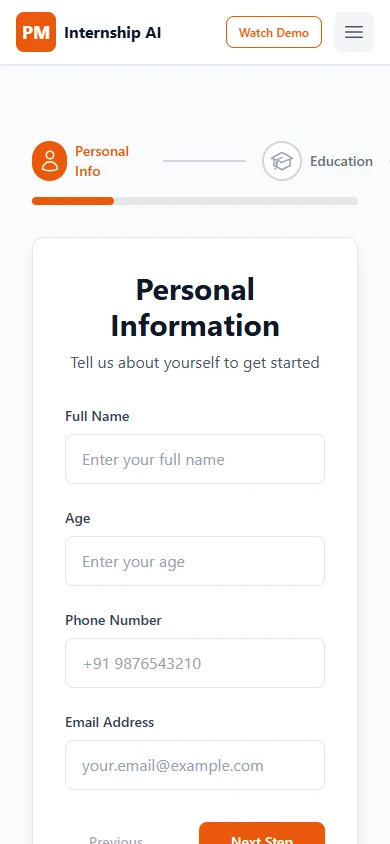
The profile form is divided into four stages: personal information, education, skills and interests, and location. A progress indicator keeps the current stage visible, while back and next controls preserve the entered information.
Technical skills, soft skills, languages, and interests use selectable choices. Location captures the candidate’s home state and preferred destinations, making geography part of the opportunity conversation.
Context before
recommendations.
Education.
Skills and interests.
Location preferences.
Keep the choices connected.
The candidate dashboard groups interests, career-path suggestions, profile improvement, and interview history. It is a place to return to after discovery and practice, rather than a separate destination with unrelated information.
The reviewed prototype includes sample career paths and match percentages. These demonstrate the interaction model; they do not establish the accuracy of an AI recommendation system.
Compare the opportunity.
See what the role asks for.
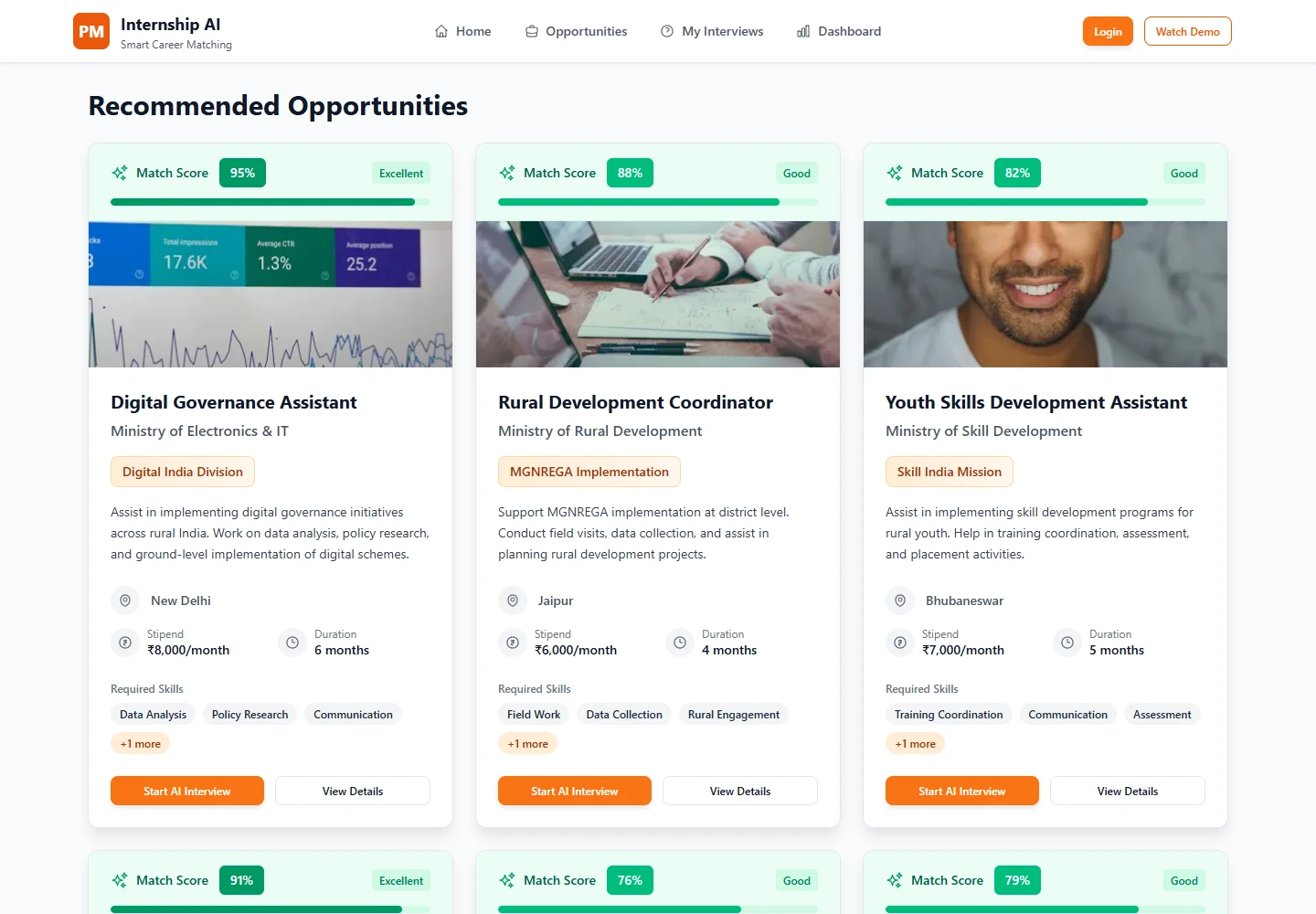
Opportunity cards combine role, organisation, location, stipend, duration, and requirements. The search component supports keyword matching across role details, plus filters for state, industry, education stream, career path, sector, work type, duration, and stipend.
Live opportunity routes read records from Supabase when configured. For the screenshots below, the original cards and interview components were rendered with the repository’s own sample records in a local capture route.
Screenshots show original components and local prototype data. Match scores, dashboard suggestions, and promotional counts are illustrative, not deployment or evaluation results.
A chance to rehearse.
A clear next improvement.
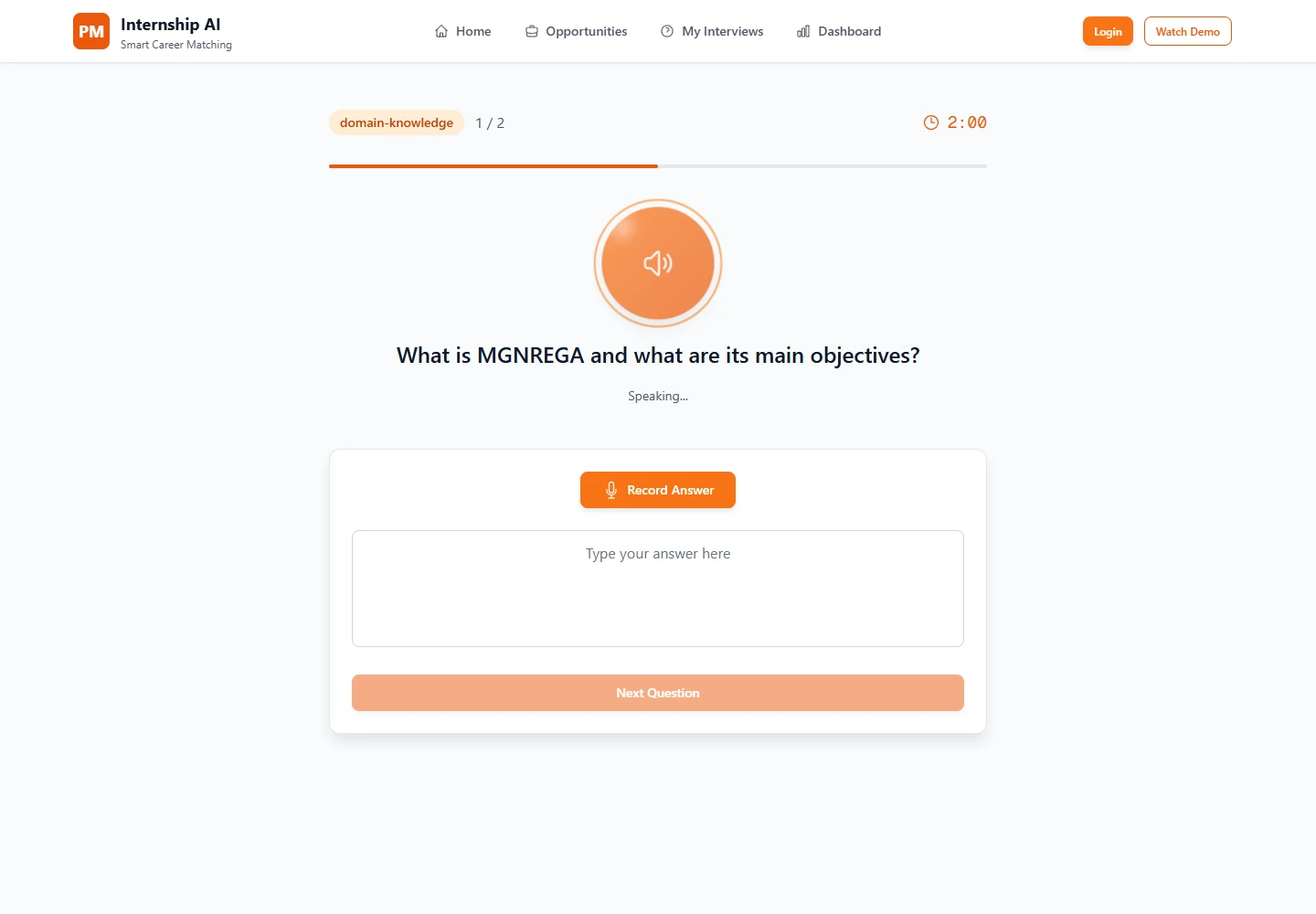
The basic interview experience begins with language selection and instructions. Each question has visible progress and timing, with playback and a choice between typing an answer and recording speech.
The interface offers English, Hindi, Marathi, Bengali, and Tamil. Browser speech recognition and recording support the spoken path; typed responses remain part of the same question flow.
Prepare
Choose language and read instructions
Respond
Type or speak an answer
Review
Score and structured feedback
Continue
Retake and explore the next role
Feedback needs more than a number.
The grading routes request an overall score, category scores, strengths, areas for improvement, and a final assessment. Categories include communication, technical knowledge, problem solving, role fit, and confidence and clarity.
The basic route can use a response-length heuristic when Gemini is unavailable. That fallback keeps the prototype responsive, but its score is an approximation. Validating grading consistency and making the scoring source explicit are further evaluation steps.
Candidate context,
carried into the interview.
The application uses Next.js 15’s App Router, React, and TypeScript. Tailwind CSS, glass-style cards, and Framer Motion support the interface. Supabase stores candidate and internship records, with additional tables for interview sessions, questions, answers, and scores.
Generate questions from the role.
The advanced generation route reads internship details, metadata, and weighted competencies. It creates a session, asks Gemini for questions with competency information and rubrics, and stores up to five generated questions against that session.
Keep the answer and assessment linked.
The advanced grading route fetches a stored answer and its associated question and rubric. It requests structured feedback, normalises the score fields, and stores the assessment. The dashboard then joins recent sessions to their internship and score records.
Separate the demo from the live service.
Live interview routes depend on Supabase records and provider credentials. The local captures use the original components with sample inputs, so they show the experience without creating candidate accounts, submitting applications, or presenting a live AI evaluation.
Explore the implementation Profiles, filters, interview sessions & grading
An internal win.
A place at SIH ’25.
The project won IITM’s internal selection and was selected for Smart India Hackathon 2025. It presents a connected candidate experience: describing a profile, exploring roles, practising an interview, and reviewing feedback.
Recognition details provided by the project author.
The next step is a measured learning loop.
The prototype establishes the interaction and integration paths. The next evaluation would test whether candidates can find relevant roles and whether repeated practice improves answer quality, with human reviewers checking feedback consistency.
The repository does not establish placement rates, recommendation accuracy, or candidate adoption. The outcome documented here is the product prototype and its IITM internal win and SIH ’25 selection.
Explore the project.
Follow the prototype and the implementation behind the candidate journey.