Nirog: care that starts
with a conversation.
A voice-first care experience, from the first symptom
to the next visit. Designed around the person.
A connected care journey.
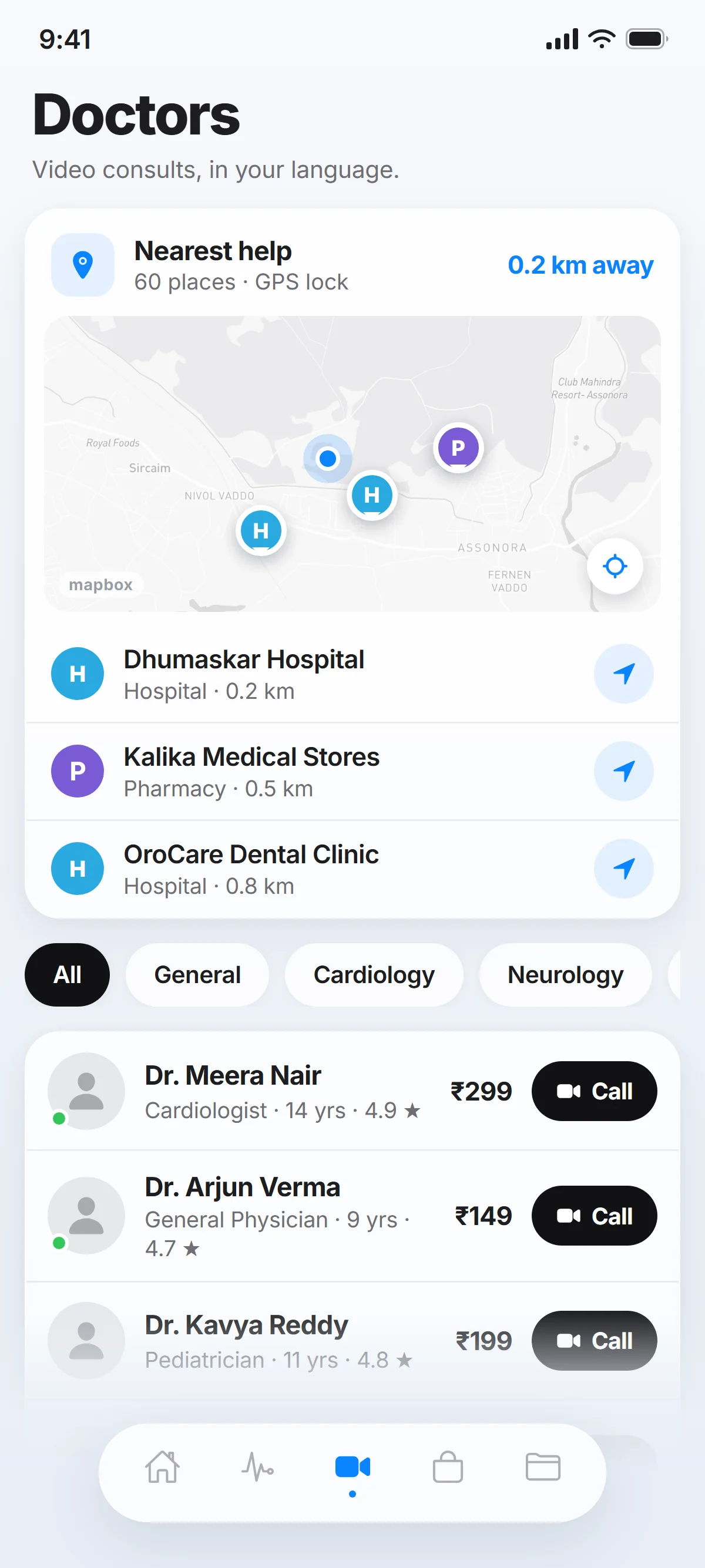
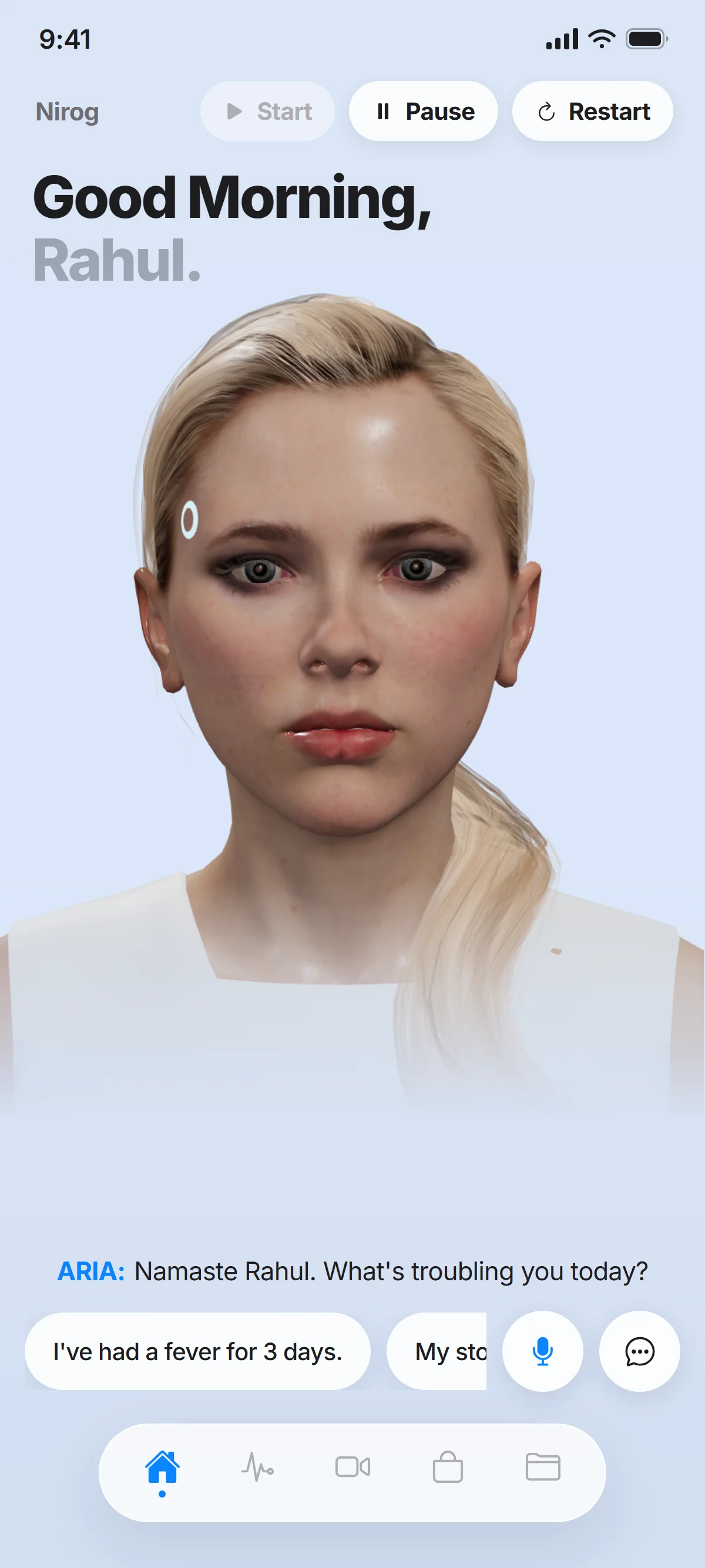
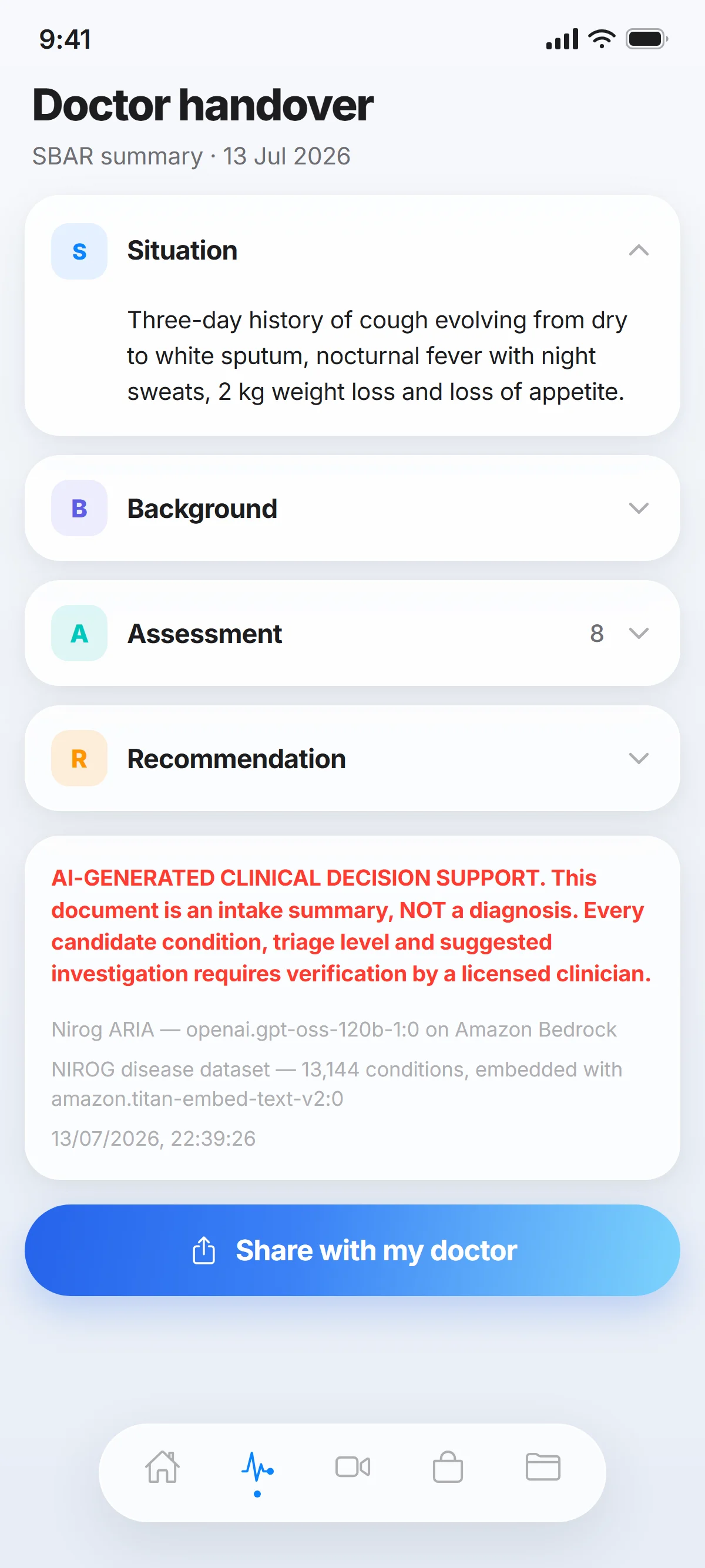
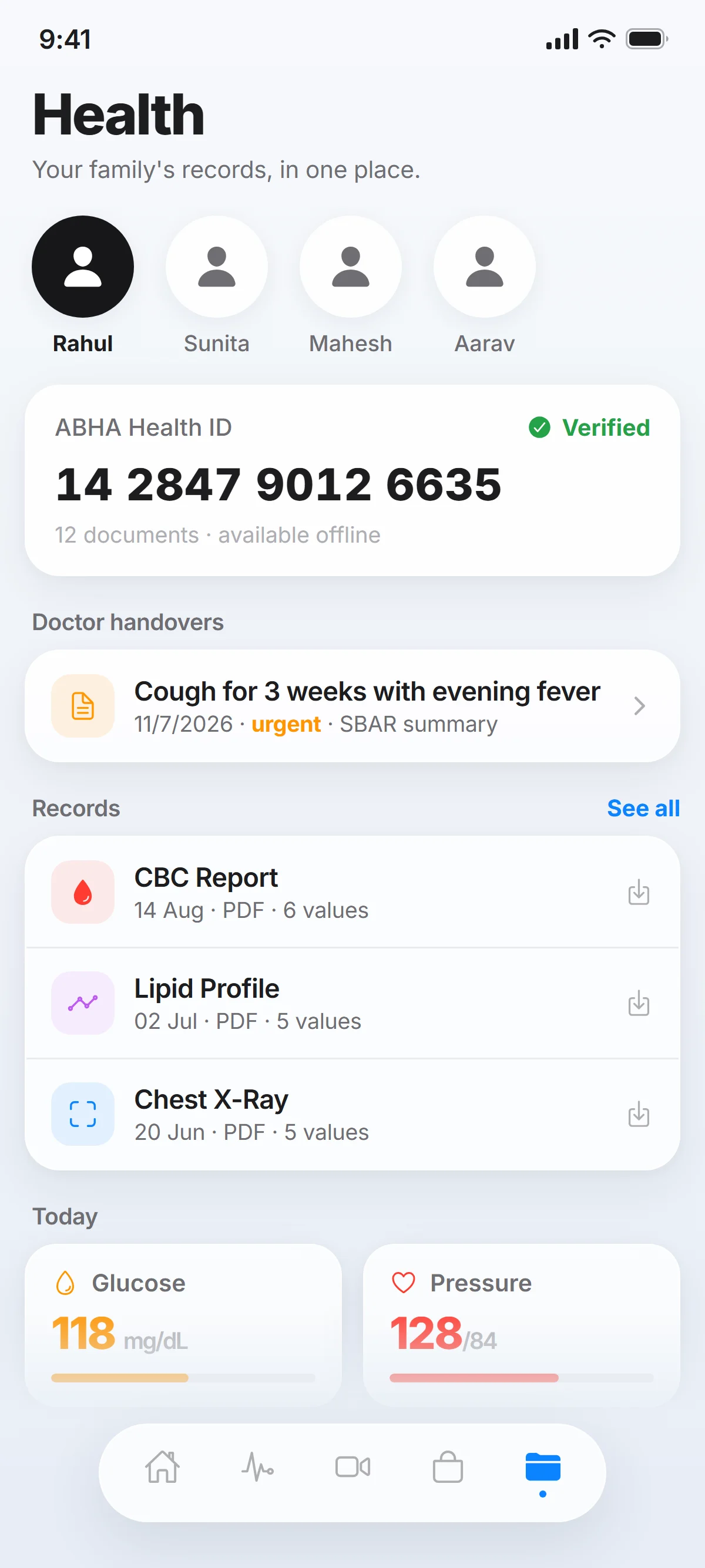
Care should begin when someone says “I don’t feel well.” We built Nirog to turn that moment into a connected journey: a conversation with ARIA, a clear handover to a doctor, and care that continues after the call.
The project earned 3rd prize in the Expo category at HACKHAZARDS ’26. This is the story of the experience we designed—and how it evolved to remember across visits.
- My focus
- Product design · Expo experience
- The team
- Aditya Gupta, Om Devi Shankar,
Shivang Shirodkar & Aditya Anand - Built across
- React Native · Next.js · CockroachDB
The bottleneck beginsbefore the consultation.
The starting point was rural access: travel, missed work, and a patient’s story getting lost between services. We framed the product around three barriers described in our original submission.
The bottleneck begins before the consultation.
The starting point was rural access: travel, missed work, and a patient’s story getting lost between services. We framed the product around three barriers described in our original submission.
Care starts with a conversation.
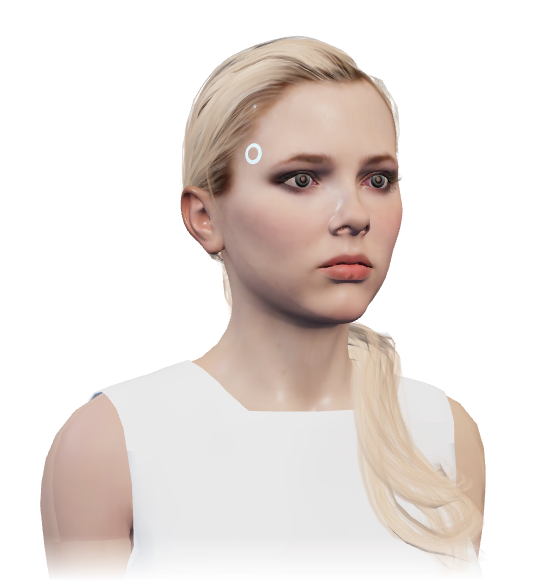
Meet ARIA. A familiar face, a natural voice, and room to explain what’s wrong in your own words. The intake begins by listening.
Voice-first intake · Live 3D presenceYour words become a real history.
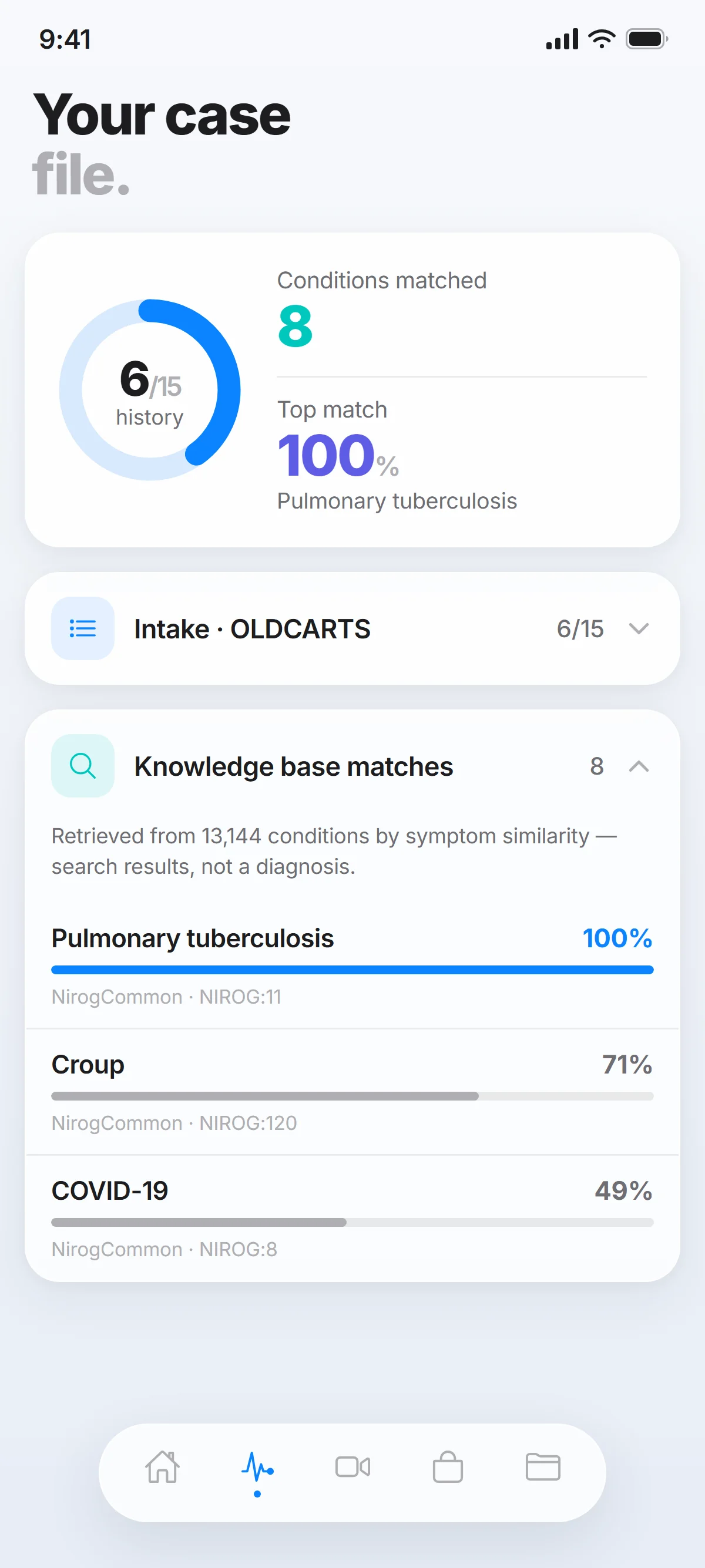
ARIA asks follow-up questions about the complaint, its onset, and associated symptoms. Each answer finds its place in a structured case file.
Guided questions · Structured clinical historySafety checks. Before the model.
A separate rule-based layer checks the patient’s words for emergency signals before AI reasoning begins. Escalation comes first when a red flag is detected.
Deterministic checks · Emergency escalationA wider knowledge base. Connected by meaning.
The conversation becomes a query against medical knowledge stored as vectors. Similarity search gathers relevant evidence for review alongside the patient’s history.
Vector database · Hybrid retrievalThe handover a doctor needs.
Situation. Background. Assessment. Recommendation. The intake becomes a concise SBAR handover, with the context ready for a clinician to review.
Structured SBAR · Clinician-led decisions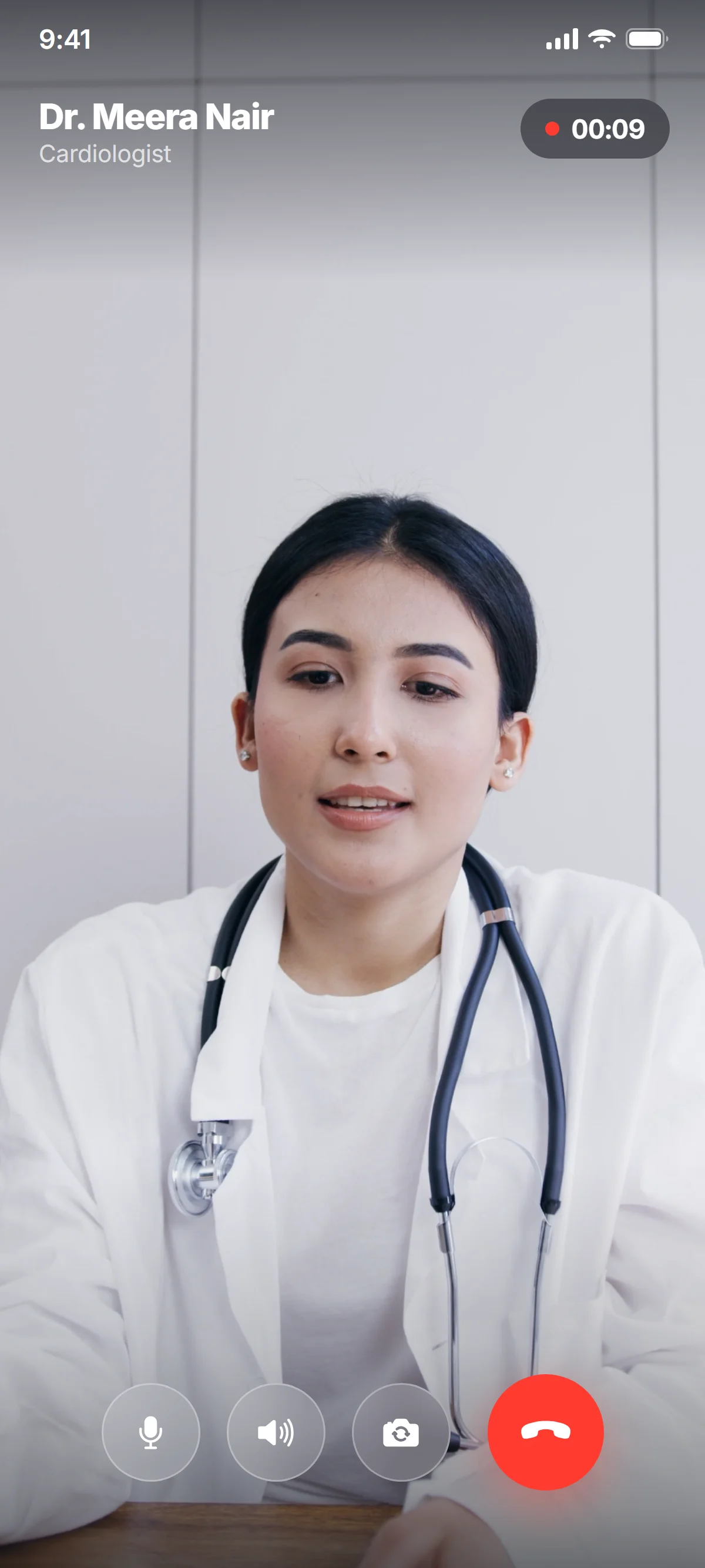
From the first words to a real doctor.
Find nearby care and connect through video, audio, or chat. The patient’s story travels with them, so the consultation can begin with context.
Nearby facilities · Video, audio & chat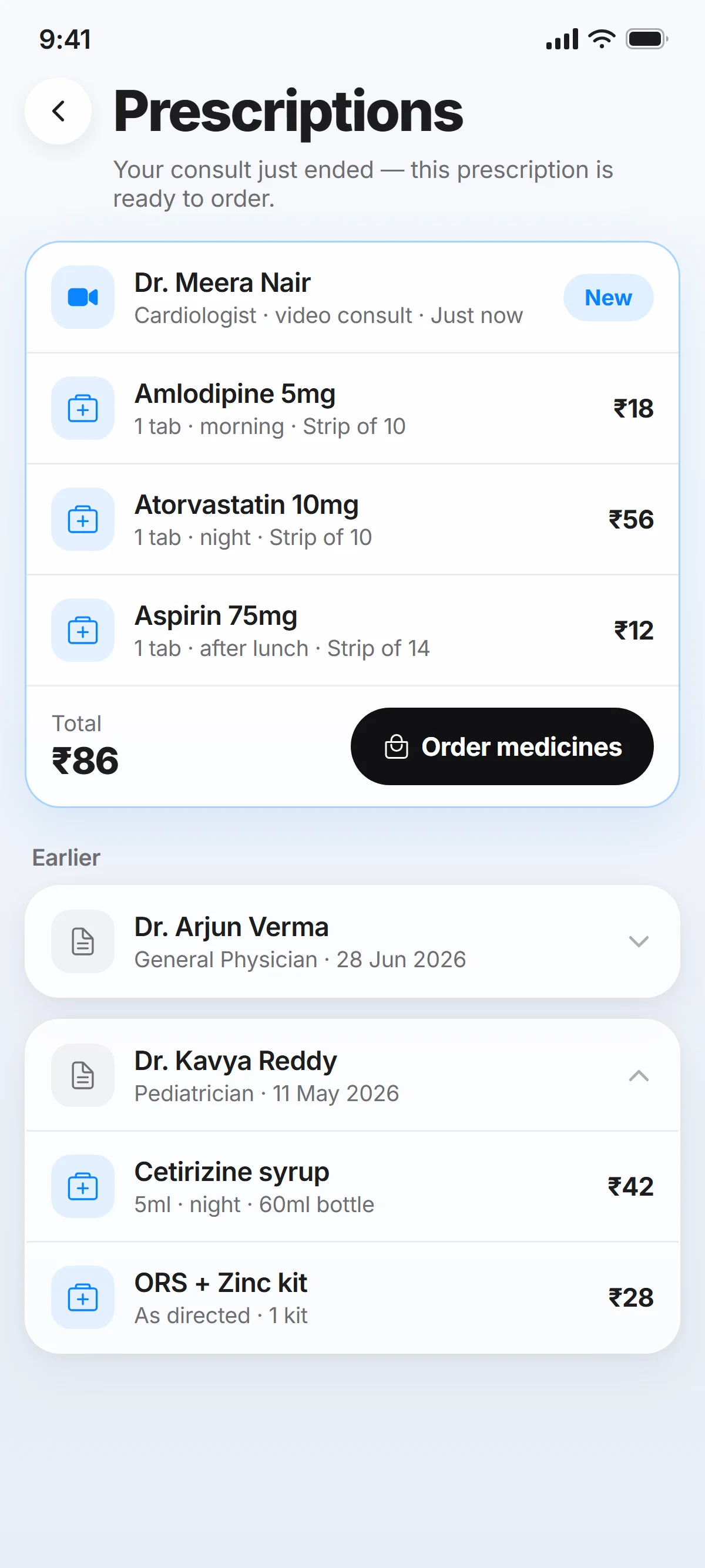
The call ends. The care continues.
The doctor’s prescription moves into the patient’s care journey. Medication lines can be passed to the pharmacy, bringing the next step closer to home.
Doctor-issued prescriptions · Pharmacy handoffYour record. With you, for the next visit.
Consultations, prescriptions, and reports come together in a family health vault. The encounter becomes part of a history the patient can carry forward.
Family profiles · Connected health recordsTyping is a barrier.
Start with speech, in the patient’s own words.
Handoffs lose context.
Carry a structured history into the consultation.
Every visit resets.
Make previous complaints part of the next conversation.
Research basis: project problem framing and prototype engineering. Clinical validation is the next step.
One continuous care loop.
Each screen has one clear job. The patient speaks; the doctor receives the context; the prescription and records carry the visit forward.
Speak
Voice intake with ARIA
Understand
Structured SBAR handover
Consult
A clinician makes the decision
Continue
Pharmacy & family records
Making complex care
feel quietly simple.
The early direction leaned into a futuristic, holographic assistant. The final “Quiet Glass” system brought the interface back to people: readable ink, soft blue light, and familiar, focused controls.
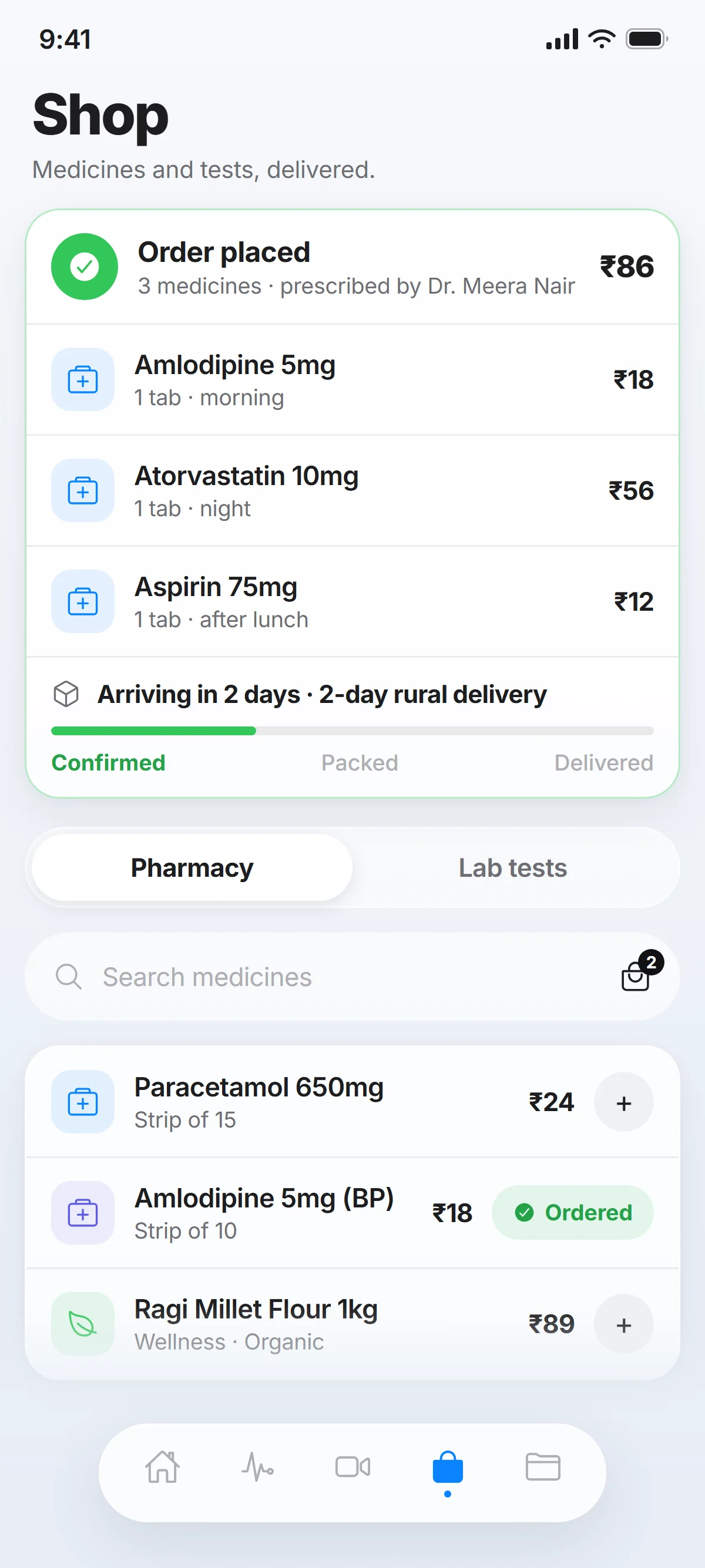
One material system
A shared glass recipe gives cards, controls, and navigation a consistent feel.
Colour with a purpose
Blue identifies AI actions. Small semantic marks carry health states.
Built for real devices
Static auroras and selective blur keep the Expo interface economical.
A voice-first start, with a familiar face and room to speak.
A face to the conversation.
A clinician in control.
ARIA listens and collects the history. Her output is a handover for a doctor. The familiar presence, voice, and lip-sync make the intake feel like a conversation, while the clinical decision stays with the clinician.
The original Chloe avatar stays with you through the intake as a live 3D model. The updated project reduced the model from 14.9 MB to 6.2 MB to keep navigation responsive on slower connections.
From “I feel unwell”
to a doctor-ready history.
The original walkthrough follows the experience across intake, consultation, and ongoing care. Start at 00:54.
The next visit shouldn’t
start from zero.
The original platform used Supabase. The updated memory experience uses CockroachDB to connect complaints across visits—even when the patient describes the same problem differently.
“My lower back has been aching.”
“Pain when I stand up from my desk.”
“The ache is back again.”
Patient-scoped recall → deterministic recurrence rule → evidence for the doctor
Memory the doctor can inspect.
Complaints and their Titan embeddings live in the same CockroachDB row. Recall stays scoped to the patient. A fixed rule counts separate visits; the chart preserves the patient’s words.
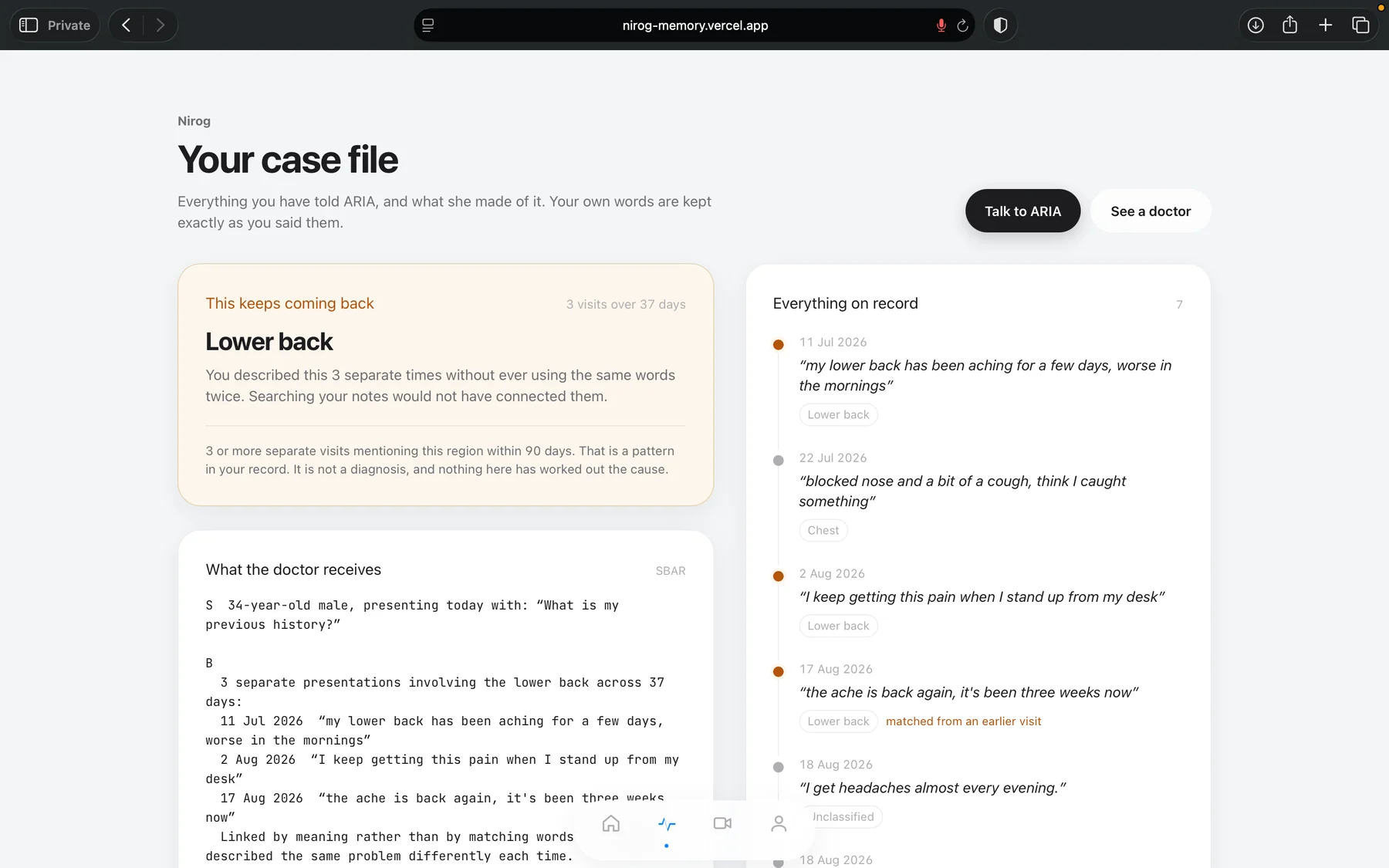
Unavailable history is a visible state.
When memory cannot be reached, the interface says “Not assessed.” An infrastructure failure must never look like an all-clear.
Explore the architecture Patient-scoped memory, voice & video
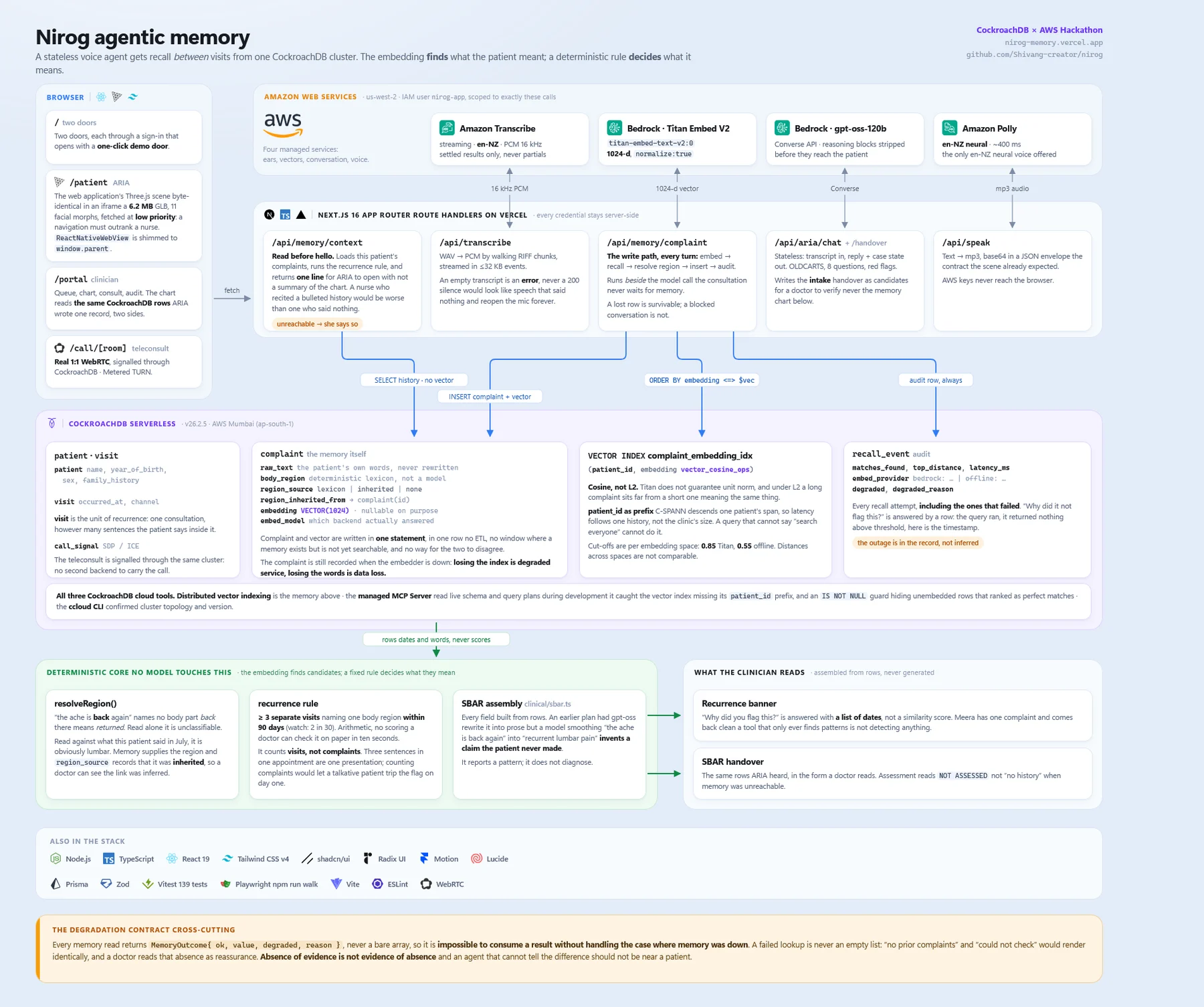
CockroachDB stores complaints, vectors, recall audit events, and WebRTC signalling. Amazon Transcribe, Bedrock, and Polly support the conversation. At demo scale, the optimizer may choose a patient-scoped scan over the vector index.
Read the engineering submissionAn award-winning prototype.
A direction worth pursuing.
Our Expo category third prize at HACKHAZARDS ’26 recognised a project that connected interface design with a working care journey. The strongest part of our story was being able to demonstrate the handoffs, not just describe them.
Expo category
What we took forward
A calmer design system.
A complete patient-to-doctor flow.
Memory that shows its evidence.
Nirog is a working prototype with seeded demo data. Hackathon recognition is a product milestone; clinical effectiveness has not been established.